January 2024 marked the end of a very long and noteworthy era for the New Internationalist magazine in Australia.
In charting how it unfolded, I want to thank those who made such a special contribution to extending the reach of the New Internationalist magazine into so many homes, schools and tertiary classes. The magazine reports on action for global justice. It promotes putting people before profit, climate justice, tax justice, equality, social responsibility and human rights for all.
Gig guide – My upcoming adventures on stage with my friends in folk music and trad jazz are detailed on my Gig Guide.
WOMADelaide – This is my favourite weekend of the year, and you’ll find some WOMADelaide stories here.
Society
Inspirational activists – I’ve been lucky enough to meet and interview some extraordinary people, activists who work tirelessly to be on the right side of history: people who know the inequity of the status quo simply isn’t good enough and must be challenged. You’ll find some activist stories here.
Planet
Saving the planet – It’s a slightly silly phrase – “saving the planet” – because the planet is quite capable of looking after itself. In fact if humans disappeared off the face of the earth, the planet would doubtless do better without us. But what we urgently need to do is to preserve our fragile life-support systems for the sake of future generations. We have a lot of work to do in both climate activism and practical emissions reduction projects. There are some examples of climate action here.
WOMADelaide is best known as a glorious long weekend of music and dance from around the world. But Planet Talks also gives some special opportunities for sharing ideas with some of the world’s most inspiring thought leaders and activists who are working on key global environmental and justice issues.
Big ideas to share
For 2023 much of the focus will be on the First Nations Voice to Parliament, the Race to Netzero, Rights for Nature and Crimes Against Nature.
The Goanna reunion performance was a wonderful emotion-charged event. It was clear they were having the time of their lives on the main stage at WOMADelaide 2022. Respect was flowing freely from and to the band.
It’s finally happened. I’m reading a book that is living up to – and exceeding – the breathless accolades of commendation on the covers. It’s a particular joy for me. In the past, with quite a few books, I read a few chapters, become a little bored, and skip to the final chapter.
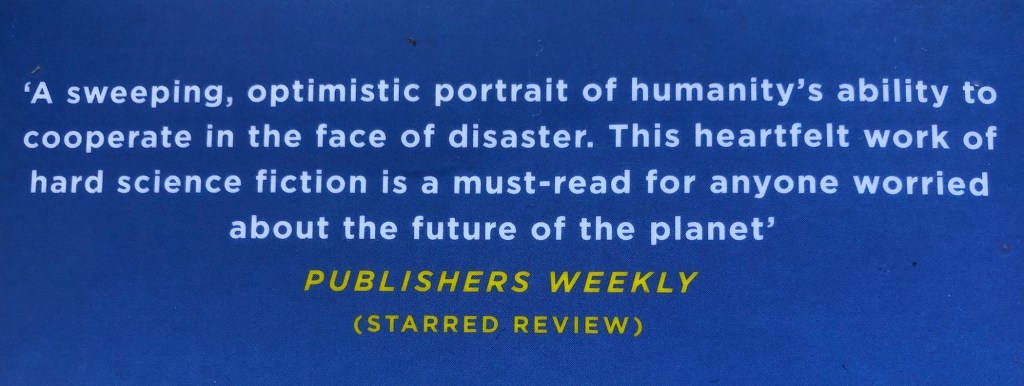
An appropriate and accurate accolade from Publishers Weekly
But not this one. I’m devouring every one of the 106 chapters over 563 pages.
It feels to me that the author has had so many ideas pent up that they decided to incorporate them all into one magnum opus. It’s fascinating.
I had a chat with Fatoumata Diawara ahead of her appearance at WOMADelaide 2019.
Brian: First of all, many congratulations on your nomination for this year’s Grammy Awards for your album Fenfo. Will you be attending the Awards Ceremony?
Fatou: Yes, I’m going to go, definitely. Last year it was the Victoires de la Musique in France, so I’m familiar with the significance of the ceremonies.
Ahead of his appearance at WOMADelaide 2018, I spoke with Chilean singer, multi-instrumentalist and song-writer Nano Stern about cultural heritage, his hopes for the future and the incomparable instrument, the human voice.
Brian: It’s been six years since we last saw you perform at WOMADelaide, and eight years since your Live in Concert album was recorded in Mullumbimby. What are the main changes we can expect at WOMADelaide 2018? Different instruments and band line-up? More influence of rock and jazz or stronger influence of Chilean roots since your return to live in Santiago?
At WOMADelaide’s Planet Talks, Vandana Shiva, Paul Sutton and Tim Jarvis will be challenging the values that we place on our land, food and water, and what these values mean for the health of our planet and ourselves.
I spoke to Dr Vandana Shiva about seeds and freedom.
Brian: You could have been a well-paid physicist, living in style in Mumbai. What first inspired you to focus on environmental activism instead? Vandana: Even while doing physics I had got involved as a volunteer in the Chipko movement that stopped logging in my home region in the Himalaya. In 1982 the Ministry of Environment asked me to assess the impact of mining in Doon Valley. The study led to a Supreme Court case and the mines were shut down. I realized then that I could contribute much more outside formal research systems, and started the Research Foundation for Science Technology and Ecology. In 1984, as a consequence of the Bhopal disaster and Punjab violence, I undertook a study for the United Nations University which was published as a book The Violence of the Green Revolution. In 1987 I was invited to attend a conference on Biotechnology, and hearing the agrochemical corporations talk about how they needed to do genetic engineering to claim patents, and how they were working on an international Intellectual Property Treaty in the GATT – which became the WTO – I made a commitment to save seeds, and build movements on Globalization, patents on seeds, and GMOs.
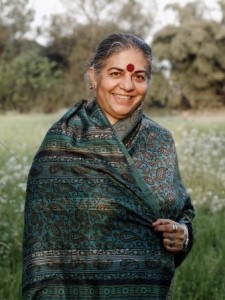
Vandana Shiva
Brian: You’ve written that quantum theory taught you guiding principles for your life’s work? How so? Vandana: The quantum principles that have guided my life’s work are non-separability – separateness is not the nature of reality; the world is interconnected. Potential – potential is the nature of reality, not fixed and immutable particles. Everything has potential to evolve. Indeterminacy – because the world is not made of fixed determinate quantities and things, but is a fluid enfolding and unfolding of potential, indeterminateness and uncertainty. Uncertainty – is the nature of being. No excluded middle, no either or.
Brian: You’ve said that “in the soil are the answers to the problem that oil has created”. What is your top priority in the Year of Soils? Vandana: My priority in the Year of Soils is to create awareness about – and love and reverence for – the living soil that supports and sustains us. We have started working on a Manifesto on Soil that will be released at the Expo in Milan which is dedicated to feeding the world. We are preparing a film of Living Soil. In September we will offer a course on A-Z of Agroecology dedicated to training in living soil and living seed. On 1st October we will organize a festival dedicated to the Soil. And from 2nd October to 5th October we will organize a Soil pilgrimage. Hope your readers can join.
Brian: Why is “Seed Freedom” so important to you? Vandana: Seed is the first link in the food chain. In seed is embodied millions of years of evolution, and thousands of years of breeding by our ancestors. In seed lies the future potential of agriculture. Seed freedom has become the most significant commitment of my life because of the threat of genetic engineering, the imposition of patent laws and seed laws that are trying to make seed saving illegal in order to establish a corporate monopoly on seed. In India, high costs of seed and chemicals have pushed farmers into a debt trap. More than 291,000 indebted farmers have committed suicide. When farmers have their own seed, they have no debt. For the freedom of seed, of biodiversity, of farmers, of citizens, we all need to be engaged in Seed Freedom.
Brian: Contamination of organic crops by GMOs from neighbouring farms is a serious concern. What can be done? Vandana: Genetic pollution of organic farms by GMOs is a new form of pollution. Environmental laws recognize that polluters must pay. In the case of GMOs corporations like Monsanto – which define seed as their intellectual property – should pay. UN Biosafety laws have a liability protocol. This should be implemented by every country.
Brian: What is your attitude to “corporate personhood” – granting corporations the status of legal “persons”? Vandana: When corporations claim personhood, they rob citizens of their personhood. When citizens of Vermont were successful in having a labelling law passed, corporations sued Vermont on grounds of their “personhood”. They have tried to argue that citizens knowing what is in their food, and making choices on the basis of that information is taking away the “Free Speech” of the corporate person. The Investor State Dispute Settlement clauses in the New Free Trade treaties such as TPP and TIPP are in fact clauses of corporate personhood through which corporations want to have rights to sue governments that act in the public good on the basis of democracy. The rise of corporate personhood is the death of democracy, the death of sovereignty, the death of human rights, the end of freedom. We cannot allow this fiction to become the basis of governance.
Brian: Food security is a focus for you. But you also stress the importance of organic production in non-food crops such as cotton. Why is that? Vandana: I have witnessed cotton farmers getting trapped in debt as a monopoly of Bt cotton was established. The highest number of suicides are in the cotton belt. We have carried out research on soil and found beneficial organisms killed with Bt cotton. We are doing a study on pollinators. There are no pollinators in Bt cotton fields. To protect our ecosystems, our biodiversity, our soil, our farmers we must promote organic cotton. Farmers using native cotton seeds from Navdanya seed banks and practicing organic production are getting double the yield and up to ten times higher incomes. They are also growing organic food crops and organic kitchen gardens we call Gardens of Hope. Since the organic cotton project has freed farmers from debt, we call it Fibres of Freedom.
Brian: Thank you so much Vandana. We very much look forward to hearing more from you at WOMADelaide.
Vandana Shiva is visiting Australia in March 2015 and will be speaking at:



 BrianLoffler